Across Pakistan, entire villages still rely on unsafe or distant water sources. The need for community water projects in Pakistan has never been greater. While individual hand pumps help families, many rural communities require scalable, shared infrastructure that serves hundreds at once.
In provinces like Sindh and South Punjab, limited access to groundwater and damaged rural infrastructure leave communities exposed to contamination and water scarcity. A strong, clean-water charity in Pakistan must move beyond isolated relief efforts and build sustainable water projects at the community level.
Village water solutions are not temporary charity; they are long-term infrastructure investments that protect health, productivity, and dignity.
The Urgent Need for Community Water Solutions in Pakistan
The water crisis Pakistan faces is not limited to a few households. It affects entire communities.
More than 21 million people in Pakistan lack access to safe drinking water. In rural Sindh and flood-affected districts, many villages without clean water depend on contaminated wells or seasonal sources. The persistent lack of safe drinking water in Pakistan leads to preventable illness and economic strain.
Community-level impact includes:
- Increased waterborne diseases
- Lost school hours due to water collection
- Reduced agricultural productivity
- Higher healthcare costs for families
When a village lacks structured access, every household suffers collectively.
Sustainable, community-scale water systems address the root of the problem, not just the symptom.
Why Community Water Projects Create Long-Term Impact
When we talk about community water projects in Pakistan, we are talking about scale. A single-family solution addresses the needs of a single household. A community-level system transforms an entire village.
This difference matters. A sustainable water charity not only reduces thirst, but it also reshapes daily life. When a properly installed system serves hundreds of people, the impact multiplies across health, education, and local productivity.
1. Reduced Waterborne Disease
Access to safe water dramatically lowers the spread of waterborne illnesses such as diarrhea and cholera. In many rural districts, contaminated wells are the primary source of disease. Community water systems provide a safer alternative that protects entire populations simultaneously.
Fewer illnesses mean:
- Lower medical expenses
- Healthier children
- Reduced strain on rural clinics
2. Time Saved from Water Collection
In villages without structured access, women and children often spend hours collecting water daily. A community-level system significantly reduces this burden.
Time saved translates into:
- Improved school attendance
- Greater economic participation
- Increased household productivity
- Reduced physical strain
When water becomes accessible within the community, daily routines stabilize.
3. Support for Agriculture and Local Institutions
Large-scale water systems do more than provide drinking water. They support:
- Small-scale farming
- Livestock care
- Community schools
- Local health centers
This broader functionality strengthens rural resilience. A sustainable water solution becomes a backbone for development.
4. Scalability and Lifespan
Unlike temporary relief efforts, structured village water solutions are designed for longevity. A properly installed solar-powered system can serve communities for 10+ years with maintenance.
That lifespan makes community water projects in Pakistan one of the highest-return charitable investments. Instead of helping 5–10 people, a single installation may serve 200–500 individuals daily.
This is what distinguishes a sustainable water charity from short-term aid: it builds infrastructure that lasts.
High-Impact Water Projects
If you are considering donating a solar water pump to Pakistan, the goal should be to scale and ensure sustainability. Community water systems are designed to serve entire populations rather than individual households.
A well-planned clean water project, Pakistan initiative focuses on long-term performance, deep water access, and reliable output for villages facing chronic shortages.
Below are the highest-impact community-level water projects you can support.
Solar Water Pumps for Entire Communities
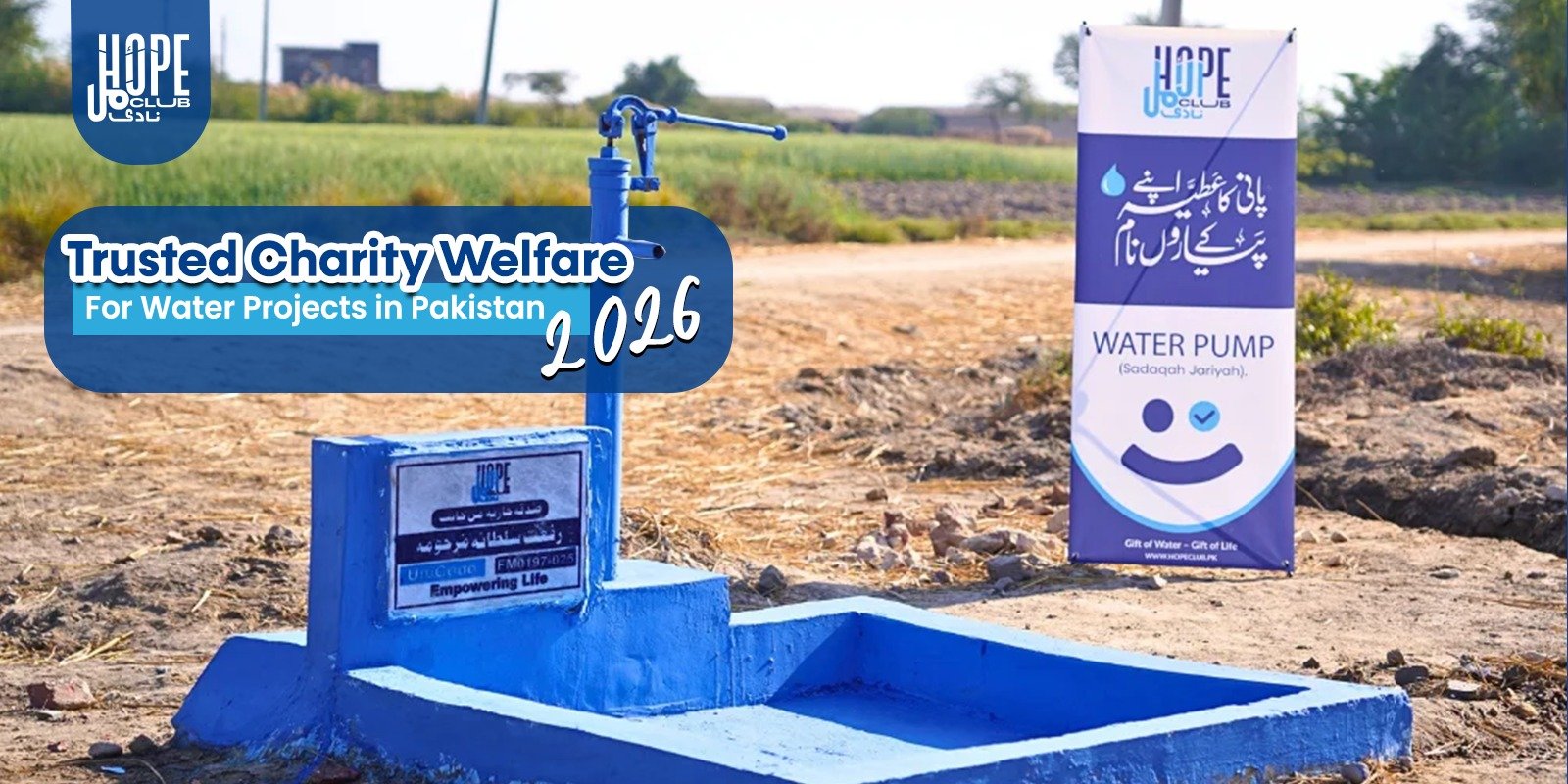
A donated solar-powered water pump, part of a Pakistani initiative, is among the most effective village water solutions available today.
Unlike manual pumps, solar systems are engineered to:
- Serve 200–500+ individuals daily
- Extract water from deeper bore levels
- Operate using renewable energy
- Deliver consistent flow throughout the day
- Function sustainably for 10+ years with maintenance
In rural Sindh and South Punjab, groundwater often sits deeper than what manual pumps can reach. Solar-powered systems solve this challenge efficiently.
From a scalability perspective:
- One installation supports multiple households
- Schools and mosques benefit
- Agricultural usage improves
- Community health stabilizes
This makes a solar installation not just a donation but a sadaqah jariyah water project with continuous, wide-reaching impact.
When you sponsor solar infrastructure, you become the source of water for an entire community.
Water Tank Projects for Emergency Regions (Secondary Effort)
While Pakistan remains the central priority for long-term community water projects, humanitarian responsibility sometimes extends beyond national borders when crisis conditions demand urgent intervention.
In regions affected by conflict or infrastructure collapse, access to safe drinking water can disappear almost overnight. In such situations, immediate stabilization becomes essential before permanent rebuilding can begin.
A water tank donation initiative in Gaza addresses this urgent gap. When municipal water systems are damaged or overwhelmed, temporary storage tanks provide structured access points where families can safely collect drinking water.
These systems are not designed as permanent infrastructure; they are rapid-response solutions intended to prevent further humanitarian decline.
Emergency water tank projects help to:
- Deliver immediate water access where pipelines are disrupted
- Support displaced populations living in temporary shelters
- Reduce dehydration risks among children and elderly individuals
- Lower the spread of waterborne illness in overcrowded areas
- Stabilize communities during periods of extreme uncertainty
In crisis environments, access to water becomes a matter of daily survival. Temporary tanks create organized distribution points that allow humanitarian teams to manage supplies more safely and efficiently.
It is important to understand the distinction between emergency stabilization and sustainable development. Unlike permanent solar systems installed in rural Sindh or South Punjab, emergency tanks are short-term tools designed to bridge a gap during a crisis. They protect lives in the moment, but they do not replace long-term infrastructure.
The lasting impact is rooted in sustainable village water charity projects in Pakistan that serve communities for 10+ years and build resilience beyond emergency conditions. Emergency aid saves lives today. Community water infrastructure secures tomorrow.
Cost Transparency: Understanding Community Water Investment
When evaluating the cost of the water project in Pakistan, the key question is not just “how much?” but “how many lives are impacted?”
Community water infrastructure spreads cost across hundreds of beneficiaries, making it one of the most efficient charitable investments.
Community Water Impact Comparison
| Project Type | Community Reach | Sustainability |
| Solar Water Pump | 200–500+ people | 10+ years |
| Emergency Water Tank | Temporary region-based relief | Short-term |
Impact Math Example
If a solar pump serves 300 people daily for 10 years:
300 people × 365 days × 10 years
= 1,095,000 instances of safe water access
That is over one million uses from a single installation.
This is why community water projects in Pakistan represent scalable infrastructure rather than temporary assistance.
When charity is viewed as long-term return on humanitarian investment, community systems consistently outperform short-term relief.
How Hope Club Ensures Transparent Water Project Delivery
Selecting a trusted water charity in Pakistan requires more than good marketing; it requires a visible process. Hope Club Pakistan emphasizes structured implementation and verification.
Monitoring & Transparency Process Includes:
- Field-level site assessment before installation
- Supervised drilling and pump installation
- GPS location tracking of completed projects
- Photo and video documentation
- Donor confirmation and reporting updates
This system ensures that every sponsored sustainable water solution is implemented properly and traceable. Transparency reduces uncertainty and builds long-term donor trust.
How to Sponsor a Community Water Project Today
If you are searching for how to donate a solar water pump to Pakistan, the process is designed to be clear, secure, and transparent. Sponsoring a community-scale water project is not complicated.
But it should be intentional. When you support a structured initiative, your contribution moves through a defined system that ensures proper implementation and measurable impact.
Community water projects are different from small, one-time donations. They involve site selection, technical assessment, supervised installation, and verification. That is why choosing the correct platform and project category matters.
Select the Appropriate Community Water Project
The first step is to identify the type of infrastructure you wish to support. Community-scale systems, particularly solar-powered water pumps, are engineered to serve hundreds of people daily. These systems are ideal for villages facing deep groundwater access challenges or areas where manual pumps cannot meet demand.
By selecting a solar water project, you are investing in:
- Long-term access to safe drinking water
- Renewable energy-powered sustainability
- Reduced waterborne disease risk
- Village-wide stability and productivity
Each project page clearly outlines the purpose, structure, and intended community impact. Reviewing these details helps you align your donation with the desired scale of change you aim to achieve.
Sponsoring a community water project is more than a transaction; it is a commitment to infrastructure that can serve a village for years. When done through verified and organized channels, your contribution becomes part of a sustainable water solution that protects entire communities.
Complete Secure Contribution
Proceed through the official website to:
- Confirm project selection
- Finalize donation amount
- Complete secure transaction
- Receive confirmation
Secure processing ensures proper allocation and documentation.
Receive Impact Verification
After installation, donors receive:
- On-site photos
- Video proof
- GPS coordinates
- Confirmation of project completion
Your contribution becomes a documented sadaqah jariyah water project serving an entire community.
Be the Source of Water for an Entire Community
Donating clean water to Pakistan at a community scale is to change daily life for hundreds of people.
A solar installation can:
- Protect children from waterborne disease
- Save thousands of collective hours annually
- Support agriculture and education
- Strengthen village resilience
One sponsorship does not serve one family. It serves a village.
Community water projects are not short-term charity.
- They are infrastructure.
- They are prevention.
- They are sustainable development.
Conclusion
Sustainable community water projects in Pakistan are not temporary fixes; they are long-term solutions that transform entire villages. When clean water reaches a community, disease declines, children return to school consistently, agriculture improves, and families regain stability.
A single solar installation can serve hundreds of people for years, multiplying its impact far beyond a single household. Supporting a structured clean-water charity initiative in Pakistan means investing in infrastructure that protects health and strengthens rural resilience.
If you choose to sponsor a community water project today, you are not just donating; you are becoming the source of safe water for an entire village.
FAQs
1. How many people can a community solar water pump serve?
A properly installed solar pump can serve between 200 and 500 people, depending on village size. It supports multiple households simultaneously. In many rural areas, it becomes the primary water source. This makes it one of the most scalable water charity solutions in Pakistan.
2. How long does a solar water pump last?
With proper installation and maintenance, solar systems can function for 10 or more years. The lifespan depends on usage and environmental conditions. Because they use renewable energy, operating costs remain low. This ensures long-term sustainability.
3. Why are community projects better than individual pumps?
Individual pumps serve one household or a small group. Community systems provide shared infrastructure for entire villages. They maximize impact per donation. This scalability strengthens overall community resilience.
4. What regions benefit most from community water systems?
Rural Sindh, South Punjab, and flood-affected districts face severe challenges to access to water. These regions often lack reliable infrastructure. Community water projects address systemic shortages rather than isolated needs.
5. How is project transparency maintained?
Site verification is conducted before installation. After completion, donors receive photos, videos, and GPS location data. This documentation confirms implementation. Structured reporting strengthens trust.
6. Can I fully sponsor a solar pump myself?
Yes. Many donors choose to sponsor a full solar water system. This allows direct, measurable village-level impact. Sponsorship creates a long-term sadaqah jariyah opportunity.
7. What makes solar pumps sustainable?
Solar pumps operate using renewable energy, reducing fuel dependency. They provide consistent output during daylight hours. Lower operational costs support long-term viability. This makes them ideal village water solutions.
8. How does community water improve education?
When water is accessible locally, children spend less time collecting it. This improves school attendance. Healthier students also perform better academically. Community systems support educational stability.
9. Is the emergency water tank support permanent?
No. Water tank projects are temporary relief solutions. They provide immediate access during crises. Long-term sustainability comes from infrastructure projects.
10. Why choose a structured water charity?
Structured systems ensure proper allocation and monitoring. Organized implementation reduces misuse. Transparent reporting builds confidence. Sustainable water charity creates measurable long-term impact.